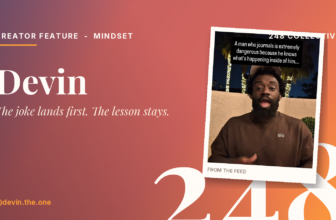



He was doing the work long before he had an audience. Then one reframed email changed who it was for. A story about depth over breadth, and the discipline of the right reps.
Jonathan Cohen did not set out to become a wellness voice for the legal profession. He was already doing the work, the training, the podcast, the writing, the daily practice, without a clear home for any of it. What changed was not the substance. It was a single line in a subject field.
For a while he had been sending cold emails about a broad personal-development idea, and they mostly went nowhere. Then he reframed the same message around a specific audience and a specific problem, wellness for lawyers, and the replies came back almost immediately. Most of the people he reached out to answered the same day. The niche had not been invented in a strategy session. It had announced itself through a signal. The audience that needed the work most was the one that recognized it on sight.
The recognition that turned it into a real practice came through the podcast. Cohen had been hosting conversations for their own sake, and one guest changed the trajectory. “One of the guests on the podcast approached me about coming on, and showed me that ‘wellness for lawyers’ is a thing,” he says. “It opened up the niche of stress management for lawyers to me where I realized, some people are talking about well-being, but that’s not how I would do it. And so I started to put my spin on it.” The opening was not a market opportunity in the abstract. It was a gap he could feel, a profession talking around its own stress without anyone treating it with the seriousness and the substance he thought it deserved.
What he built into that gap is unusual mostly because of what he refuses to do with it. Cohen treats the podcast as a lifelong practice rather than a funnel. “My relationship with my podcast is so healthy right now,” he says. “It’s healthy because I put zero pressure on myself, but it’s always there.” The absence of pressure is the point. He is not optimizing for downloads or for a posting cadence. He is optimizing for conversations he actually wants to have, which is why he is willing to turn down guests who would help the numbers but not the work.
That willingness comes from a filter he applies almost everywhere. “I have a filter, that if I’m not curious about it, I don’t do it,” he says. He encourages the same starting point in anyone trying to build something durable: “Start with things that you’re super curious about.” Curiosity is not a soft preference for him. It is a forcing function that keeps the work honest, because the things he is genuinely curious about are the only things he can sustain at depth over years rather than weeks.
I have a filter, that if I’m not curious about it, I don’t do it.
The discipline has a harder edge too. Cohen talks about alignment as a practice of subtraction, of knowing what to walk away from. “You have to have the discipline and impulse control to walk away from things,” he says, “and more importantly, you have to vet these things.” The opportunities that look like wins are often the ones that pull you off the line you have chosen. Saying no to them is not caution. It is how the ‘yes’ stays meaningful.
Underneath all of it is a model of performance he has thought about carefully. Cohen does not believe the goal is to eliminate stress. He believes the goal is to find the right amount of it. “If you’re not stressed enough, you can get bored,” he says. “You need to have that right zone of optimal performance, that zone of genius.” Too little load and the work goes slack. Too much and it breaks. The skill, the one he now teaches to rooms full of attorneys, is learning to find and hold the zone in the middle, and to navigate the peaks and valleys of a demanding life with some measure of grace rather than white-knuckling through them.
The proof that the approach works did not come from a marketing plan. It came from showing up. “If it wasn’t for this podcast, I wouldn’t have even started publicly speaking and training thousands of lawyers,” he says. The speaking followed the conversations. The paid inbounds followed the speaking. None of it was reverse-engineered from a revenue target. It compounded because the underlying practice was real, and because he kept doing it long enough for other people to notice.
Cohen is honest that the path ran through a lot of rejection. The compounding he describes is not the story of a clean ascent. It is the story of being willing to look foolish repeatedly. The skills build, he says, when you keep going: “Starting a podcast, sending out thousands of cold emails over the course of my career, getting rejected countless times, but being bold enough to try.” The boldness is ordinary and repeated rather than dramatic. It is a tolerance for the discomfort of trying before you are certain it will work.
The next of those attempts is a book. Cohen is writing a collection of forty life lessons, each a short chapter of two to five minutes, and he is aiming to have it done by the end of 2026. He is exacting about how it should feel. He wants it short, readable, and entirely his own, “with zero citations except for the people that I quote, all original, and really not using AI for anything.” In an era when most content is being optimized and automated, he is deliberately doing the opposite, betting that something made by hand and built on lived experience will mean more, not less.
Cohen is not trying to reach everyone. He is trying to reach the right people at depth, with work he believes in, made in a way he can stand behind, and to let that compound on its own. The wellness niche found him because he had the substance before he had the positioning. What he has done since is refuse every shortcut that would have traded that substance for speed.
The 248 Collective exists to tell exactly these stories: the disciplines people build away from the title, the practices that hold a life together, the quiet work that compounds into something visible. Jonathan Z. Cohen is building a platform the way he believes anything worth keeping gets built. Consistency with integrity. The right reps. Depth over breadth, every time.